
Indian benchmark indices Sensex and Nifty surged over 1 per cent, with the Sensex jumping 918.60 points, driven by strong buying in banking and financial counters and a positive trend in global equities, fuelled by hopes of easing West Asia tensions.

The Indian rupee plummeted to an all-time low of 95.80 against the US dollar, settling at 95.66, driven by elevated crude oil prices and escalating geopolitical tensions in West Asia, despite potential RBI intervention and import curbs on gold.

The TMC has intensified its attack on the BJP, alleging a 'larger conspiracy' involving central agencies ahead of the second phase of West Bengal polls on April 29, while also questioning the credibility of the Election Commission.

The Aam Aadmi Party (AAP) held protests across Punjab against the Enforcement Directorate's (ED) action against state minister Sanjeev Arora, accusing the central government of misusing agencies against its leaders. The BJP criticised the AAP workers' behaviour during the protests.

Karnataka Chief Minister Siddaramaiah has called for the establishment of a Supreme Court bench in South India to improve accessibility to justice. Speaking at a conference on Artificial Intelligence in the judiciary, he also highlighted the need to address algorithmic bias and ensure judicial independence in the age of AI.

Two top executives at the British Broadcasting Corporation (BBC) resigned on Sunday amid an escalating scandal over impartiality and bias, as reported by CNN.
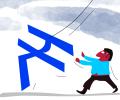
The Indian rupee depreciated by 52 paise to settle at 93.35 against the US dollar, driven by failed US-Iran peace talks, surging crude oil prices due to a potential US blockade of Iranian ports, and a global flight to the greenback. This geopolitical uncertainty is also leading to foreign capital withdrawal from domestic equities.

Nearly two-thirds (63.7 per cent) said they had, at some stage, found the profession discouraging.

The Gujarat High Court has issued a policy prohibiting the use of Artificial Intelligence in judicial decision-making, reasoning, and judgment preparation, emphasising human oversight and limiting AI to administrative support roles.
The Indian rupee experienced a significant surge against the US dollar following the Reserve Bank of India's measures to restrict banks from onshore forward markets. Despite this, the rupee remains under pressure from foreign capital outflows, a strong dollar, and rising crude oil prices.

'A genuine tribute to Dr Ambedkar does not lie in selective invocation. It lies in asking a harder question: Is the Constitution still doing its job -- restraining even assertive majorities?' asks Manoj Mohanka.
Supreme Court judge Justice B V Nagarathna stated that judicial independence in the modern era includes freedom from algorithmic influence, emphasising that AI should only assist judges, who must ultimately decide based on constitutional values and human judgment.
Education experts are advocating for the integration of artificial intelligence (AI) education in schools, emphasizing the need for age-appropriate implementation, data privacy awareness, and the use of vetted AI tools within secure school environments.

'We are staying away from making forward-looking statements on when we will reach 1 trillion, etc. But growth will be rapid; it's only a matter of time.'
Supreme Court judge Justice B V Nagarathna stated that judicial independence in the modern era is not just freedom from external power, but also from algorithmic influence, while speaking at a conference in Bengaluru.

A Pune college refutes allegations of caste bias by a former student who claimed the college withheld job verification, leading to job loss. The college clarifies it sent the document and the student did not lose his job.

The Indian government has dismissed the US Commission on International Religious Freedom's (USCIRF) report on religious freedom in India, stating that it does not recognise the commission's authority to comment on the rights of Indian citizens.

'If the Opposition associates itself too much with the minorities, then it becomes easy for the BJP to get Hindu consolidation votes.'

Chief Justice of India Surya Kant cautioned against the uncritical adoption of AI in the judiciary, emphasising the need for human judgement and ethical considerations in judicial decision-making.
Chief Justice of India Surya Kant has cautioned against the uncritical adoption of Artificial Intelligence in the judiciary, emphasising the need to balance technological advancements with human intellect and ethical considerations.
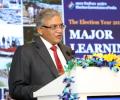
Opposition MPs in India have moved notices in Parliament seeking the removal of Chief Election Commissioner Gyanesh Kumar, accusing him of bias, misconduct, and acting under the influence of the executive.

The Supreme Court of India has announced its intention to establish an effective mechanism to address caste-based discrimination in educational institutions throughout the country. The court directed the University Grants Commission (UGC) to draft regulations to prevent such discrimination and to provide data on institutions that have implemented equal opportunity cells as mandated by the 2012 UGC equity regulations. The court's decision stems from a public interest litigation filed in 2019 highlighting the prevalence of caste-based discrimination in higher education institutions and its tragic consequences, including the suicides of students like Rohith Vemula and Payal Tadvi.

BCCI Ethics Officer Justice Arun Mishra (retd) has dismissed a petition filed against former Indian captain Mahendra Singh Dhoni, accusing him of violating of conflict-of-interest provisions.

Indian equity investors experienced a significant loss of 16.32 lakh crore due to a two-day stock market decline fueled by escalating geopolitical tensions involving the US, Israel, and Iran.

Mamla Legal Hai 2 draws humour from its assorted characters, crafting quirky storylines inspired by newspaper headlines, and anchored by consistently strong performances, led by an ever-reliable Ravi Kishan, applauds Sreeju Sudhakaran.

The University Grants Commission's (UGC) new regulations on promoting equity in higher education institutions have sparked protests and legal challenges. This article explains the regulations, the concerns raised, and the government's response.

A plea has been filed in the Supreme Court challenging a University Grants Commission (UGC) regulation, alleging it has a non-inclusionary definition of caste-based discrimination and excludes certain categories from institutional protection.

The Indian rupee weakened against the US dollar due to rising crude oil prices, geopolitical tensions in the Middle East, and foreign fund outflows.

Stock markets closed higher for the second straight session on Tuesday, driven by gains in bank, IT and capital goods shares.

From the Sensex firms, Tata Steel tanked the most by 4.57 per cent. ICICI Bank, Power Grid, HCL Tech, Tech Mahindra, Infosys and Kotak Mahindra Bank were also among the laggards. Mahindra & Mahindra, State Bank of India, ITC and Bharat Electronics were among the gainers.
A senior health expert warns against the growing trend of using AI for self-diagnosis and treatment, emphasizing that these tools should not replace human clinical judgment.

'India's ties with Israel have to do with defence and general technology.' 'The war changes nothing in what India and Israel hope to get from the relationship.' 'It's not as though India will get significantly more benefits from Iran if India abandons Israel at this time.'

The rupee appreciated 13 paise to close at 90.34 against the US dollar on Thursday, on trade deal optimism and overnight decline in commodity prices, even as the upside remained capped as investors look for more clarity on the India-US trade deal.

The increasing use of models, algorithms, and code across the financial industry is reshaping how outcomes are generated. However, their limitations, such as explainability, embedded bias, and model drift may not be immediately apparent and may emerge only as these technologies gain scale, warns RBI deputy governor Shirish Chandra Murmu.

'What has changed is that the new regulations are backed by a clear enforcement framework. They have real consequences and, for the first time, make compliance unavoidable.'

The new UGC regulations mandating all higher education institutions to form "equity committees" to look into discrimination complaints and promote equity were notified on January 13.

'Large firms and their interests can dominate the narrative, even as smaller stakeholders and retail investors struggle to be heard.' 'Regulators therefore require deep subject-matter expertise to assess representations, recognise underlying incentives, incorporate the perspectives of less-visible stakeholders, and guard against bias or capture,' notes Ananth Narayan.
'Once the actual scope is understood, it becomes evident that the framework is about internal redress and course correction, and in no way criminalisation.'

The Supreme Court's stay on the UGC equity regulations aimed at preventing caste-based discrimination on campuses has been met with mixed reactions. Opposition parties welcomed the decision, while some expressed concern over the implications for marginalized communities.

Benchmark stock indices Sensex and Nifty dived sharply by nearly 2 per cent on Sunday after Finance Minister Nirmala Sitharaman proposed a hike in the Securities Transaction Tax (STT) on derivatives. Reversing the early gains, the 30-share BSE Sensex plunged sharply by 2,370.36 points or 2.88 per cent to slide below the 80,000-mark at 79,899.42 in afternoon trade as the finance minister announced a hike in STT on futures contracts to 0.05 per cent from the current 0.02 per cent.
